14 November 02013
Round-up of recent and current work
In the four-minute video below, I describe how a small charity created a Massive Open Online Course (MOOC) for over 1,000 people. This was the open course in Technology Enhanced Learning (ocTEL) which I managed from inception to completion of its first run. This is one of a set of films about projects that the Association for Learning Technology has recently published.
ocTEL is one of the major projects I've been working on over the past year. Here are some others.
- For Myscience, which runs the national Science Learning Centres and National STEM Centre, I co-wrote an Online Strategy for the continuing professional development which they provide to teachers. My company was the lead contractor for a team including Seb Schmoller, David Read, Dominic Tinley and Jonathan Drori. Having got approval to proceed the strategy from Myscience's stakeholders, we are now exploring how we might help with implementation.
- The work that I mentioned last year to provide support to support to learned societies considering the transition to Gold Open Access publishing is now available. The publishing businesses of learned societies operate in a complex ecosystems with a rich variety of disciplinary traditions and institutional histories. Being helpful is not always as easy as it might seem.
- Following last year's work for the Higher Education Academy — to reorient their online resources to make them more useful to teaching communities of practice — Knowledge Integration won a contract to implement a new repository and take forward some of the recommendations. I am helping them ensure that the implications of this for the user experience are borne in mind.
- My main current project involves the creation of another large-scale online course for adult learners. The Citizens' Maths project aims to develop free and open online maths course that could support hundreds of thousands of learners. The first run of the first part of the course is scheduled to be next summer. The project page has more details. I am the project manager.
Meanwhile, I had hoped to revamp this website this year, but it is now likely to be some time into 2014 before this happens. It still runs on the same Movable Type platform as it did ten years ago. If you know anyone who understands the details of making the transition to Wordpress (including maintaining old URLs so that inbound links here are not broken), please ask them to get in touch. I will pay well for the right kind of help. And once that transition is complete, more frequent blogging will follow.
2 October 02012
What I did last summer
To state the obvious, I have blogging block — a fairly chronic case of it. The reasons for this, and my abortive attempts to overcome it, are fascinating from one perspective; self-indulgent from another. Therein lies part of the riddle that has undone me. Suffice to say, for now, that I still believe in the value of reflective writing about experience, and of sharing half-formed thoughts as part of a conversation with people who share my interests. I plan to get back to it.
Lest you imagine that I have just been convolving with my navel these past months, here's a quick resumé of recent and current projects:
- Working with University of Derby Online to explore the feasibility of developing online Access to HE provision. This was a small project and in one sense it focused on a very specific question within quite a restricted canvas. In another sense it raised big issues about how to make Higher Education more accessible, less rigid and better suited to the lives of people who weren't 'bred' to be full-time students. More agile, in my terminology.
- Working with the Higher Education Academy to advise how to reorient their online resources to make them more useful to the diverse communities of practice — across HE teaching — that the Academy supports.There are subtle, but profound, changes afoot as national agencies navigate the transition from publisher-cum-gatekeeper role to being more facilitative in the era when open online resources are distributed and abundant.
- Managing a project to identify the support that scholarly socities need to make the transition to Gold Open Access publishing, which has been given a shot in the arm in the UK by the Finch Report. Our project then aims to commission or produce resources to help meet those needs for support. I'm project manager on behalf of the Association for Learning Technology (ALT), who have been commissioned by the Open Access Implementation Group.
- Also for ALT, I'm managing the Open Course in Technology Enhanced Learning project (the website hasn't been formally launched yet, so no link, but you can find it if you dig). This is also aimed at teachers in higher education, encouraging them to explore the ways they could use technology in their teaching. The course is a MOOC — Massive Open Online Course. The soul of MOOCs, whether saintly or demonic, is hotly contested at the moment, especially among learning technologists, so it's an interesting time to be designing such a course. It's due to run next year.
For all but one of these projects, I've been working with my regular collaborator Seb Schmoller. While I've been working on them — and I was also fortunate enough to be invited on two holidays this summer — my work on Agile Learning has moved on to the back burner. Most recently I got the Agile Learning wiki to the point where almost stands by itself as an introduction to the principles and practice. I also wrote a series of articles for New Media Knowledge — here's the round-up that points to the three main articles. I expect to stay with the agile theme for as long as I continue to do anything that could pass as work, but for now the Agile Learning blog, twitter, Facebook and Google+ (!) are lying mostly fallow until the season changes.
22 May 02012
Tom Phillips and A Humument: Essays, notes
 A year ago, almost to the day, I got an email out of the blue from Lucy Shortis, who runs the office of my favourite artist, Tom Phillips. She said some nice things about a very old blog post of mine, and asked if I would consider writing a "short biography of Tom" for a new website for him. I drummed my fingers on my desk for half an hour before replying, thinking it might seem creepily over-keen to accept the challenge within five minutes. Still, I was round at the studio to discuss the work with Lucy the next morning, a Saturday.
I already had several books of Tom Phillips' work, none of which I'd given as much attention as I would have wished. (I used to think of these enormously rich works as resources to keep me alert in my retirement. Via this commission, I enjoyed the luxury of bringing forward a few weeks of that retirement.) One of the first things I did was track down and buy some more of his books. To a dabbling hobbyist like me, Aspects of Art was particularly useful in providing a concise, straightforward account of both Tom's perspective and the grammar of art history that he draws on.
It took me weeks of research before I felt ready to start writing, and, thus when I did I was so marinated in the rich play of ideas in Tom's work, that I couldn't quite bring myself to write a 'straight' biography. My first attempt was well over the word limit and so wide of the mark that I had to put it to one side. No matter. Try again. With a little guidance from Lucy, I came up with this attempt which went live with the new website a couple of weeks ago. Moreover, Lucy was kind enough to indulge me by finding a home for my original essay.
The new website is one of a series of happenings this month that mark Tom Phillips' 75th birthday. (There's a neat symmetry about this number for me, since I first encountered Tom's work at his 1987 exhibition in Sheffield, "50 Years of Tom Phillips, 100 Years of the Mappin Art Gallery".) Other birthday events include two exhibitions in London and the publication of the fifth edition of Tom's book A Humument, which he's been working on for 46 years and counting.
Regarding the last of these, I pitched to The Spectator to write an article about A Humument and you can read it in the current edition of the magazine or online. Once again, my first draft of this went way over the word limit and included playful embellishments that had to be cut for publication. Now I've gone back to that draft to create a "Director's Cut" version. Like most Director's Cuts, it's by no means better than the version where I had my wings clipped: it rambles along down several diversions; it has pretentious flourishes; its editing is baggy. If you want a decent overview of A Humument, read the Spectator piece. If you're part of the niche audience that's interested in a few of the many different directions in which A Humument leads, this is for you.
Continue reading "Tom Phillips and A Humument: Essays, notes"2 March 02012
Deskilling Learning? On "strong" and "weak" agile learning
Having saddled myself with the agile learning term, one of the hazards I can't complain about is having to explain it: What does it really mean? What's different about it? What's agile about it. There's a working definition of the key elements on the agile learning wiki, which I continue to develop slowly and sporadically. Recently I've been reflecting on some more nuanced, but still half-formed, ideas, which feel more like blog-conversations than wiki-definitions. These are partly prompted by reading Douglas Rushkoff's excellent Program or Be Programmed (which deserves a blog post of its own), and also by the Learning Analytics course, devised by George Siemens and colleagues, which I'm currently participating in (and blogging about in detail over here).
What I'm toying with at the moment is a distinction between "weak" agile learning and "strong" agile learning. This is after John Searle's distinction between "weak" and "strong" artificial intelligence, but I suspect this kinship may be tenuous and, certainly, vainglorious. They might equally well be called, say, pragmatic agile learning and principled agile learning — or something else.
- Weak agile learning is based on whatever works, as long as it's within the definition. Analytics, automated processes, traditional tutor-led power relationships are all fine if they're open (as in open educational resources), collective and flexible.
- Strong agile learning is committed to the values of making everything — process, resources, algorithms and the context in which the learning is framed — visible, transparent and manipulable to the learner. So it's taking a more radical definition of openness.
The weak version allows for things like intelligent curriculums, gamification and personalisation by the provider. The strong version wants to trust in learners' intelligence and give them the information and the data to personalise their own experiences.
Pragmatically, I'm drawn to the weak version. I distrust purism, believing every oyster needs some grit (for most of my three decades as a vegetarian, I've eaten meat a few times a year). But ethically and aesthetically I feel the strong version needs shouting about, because gung-ho enthusiasm for the Big Data/Scientific Management seems to be leading down a dangerous path. Let me explain.
Continue reading "Deskilling Learning? On "strong" and "weak" agile learning"23 January 02012
Notes on Emergent Learning
As part of updating the wiki on agile learning, I've been reading up on Emergent Learning. As long ago as 2004, Michael Feldstein was arguing that "Emergent Learning" is an oxymoron. In brief, his argument was that the term was being used very loosely to describe any circumstance where learning emerges as a by-product of collective activity. Certainly that looseness still exists in some accounts. However, I'm interested in digging into a couple of examples where the term may be applicable in the strict sense to which Feldstein is committed. It turns out that this leads to some counter-intuitive conclusions.
Here is the nub of Feldstein's argument:
[S]ome philosophers of mind suggest that consciousness is an emergent property of brains. Each individual neuron is simply a mechanical switch responding to triggers in its immediate environment. But when you string a bunch of these switches together in the right way, you suddenly have an aware being. The neurons aren’t individually conscious; it’s the brain as a collective entity that posesses the emergent property of consciousness.
When people talk about "emergent learning" these days, this is not generally what they mean. What they generally mean is some form of rapid consensus-building in which a group of people can share observations and make coordinated decisions without any one person filling the role of executive command and control. This is, no doubt, an important phenomenon to understand and try to cultivate. However, it is not emergence. A democratic decision-making process is not sufficient for an action to be called "emergent." Almost by definition, if you have the kind of self- and group-awareness that is usually entailed when we use the word "learning", you can’t have emergence. You can say that a colony of ants "learns" what the best foraging strategy is, but it is the colony as a whole that "learns," not the individuals. If the individual ants were able to learn the best foraging strategy, communicate it throughout the hive, and consciously arrive at a consensus, then their adaptive foraging would not be an emergent behavior. So "emergent learning" as the term is currently being used is actually an oxymoron.
Remember this: none of the ants has learnt, or knows, the strategy, but collectively they can put it into action. If you look at the case studies in this recent Special Issue of the International Review of Research in Open and Distance Learning on "Emergent Learning, Connections, Design for Learning," it's clear that the learning and knowledge of individuals remains the primary focus. "Emergent" in this context seems to be another way of describing the knowledge and skills — some of them tacit — that individuals accrue from taking part in self-organised and/or very fluid learning experiences.
By contrast, look at this from A New Culture of Learning by Douglas Thomas and John Seely Brown. It doesn't use the term "emergent learning" but nevertheless describes the kind of collective (not individual) mastery that Feldstein insists is the mark of true emergence. So here emergent learning would not be an oxymoron?
Continue reading "Notes on Emergent Learning"20 December 02011
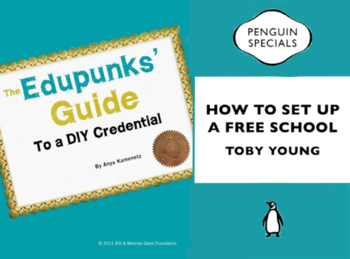
School it Yourself: Review of The Edupunks' Guide and How to Set Up a Free School
We're in one of those periods when real change in education might be possible. This doesn't happen very often. Here's why. Education is probably the single most powerful means by which our societies and our cultures reproduce themselves — institutions, values, character and differentials… the works. Hence the number of interest groups with a stake in education is enormous. Of all the culture-breeding channels available to those in power, education is in principle the one that lends itself most readily to engineering and design. However, in practice, everyone sticks the oar in and change is piecemeal, compromised and fragile.
So it's rare for sufficient powerful forces to align and overcome the drag of inertia. Now is such a time, and I think we're just seeing the beginnings of changes that may take a decade or two to work through. Donald Clark writes of technology enabling "more pedagogic change in 10 years than in the last 1,000 years". Then there's the impact of economic retrenchment and austerity on learning, which I've been writing about on and off for over two years, arguing that cases where people have to "make do" in their learning may have something to teach us about how to improve more "advanced" techniques.
On top of factors like these (the full set would be a whole essay in itself), there's a cultural mood that has arisen from year-upon-year of different kinds of disruption — from hurricanes and ash clouds, through financial punch-drunkenness to the effects of technology reaching the professional middle classes for the first time. We don't believe in the return of business-as-usual any more; we don't trust the age-old educational conveyor belts to drop us off at the right spot in the factory.
In different ways we're questioning the educational provision that's been handed down, and wondering if we couldn't do better ourselves. Let's explore what I mean by that by looking at two "How To" e-books about education, published in recent months. In many ways they're chalk and cheese. One's American, the other British. One is a student's-eye view, the other a parent and school-builder. One is very "2.0" in its sensibility, arguing that students can remix their learning experiences from multiple sources. The other is, well, the mischief in me would like to call it Web 0.0, but really it's from a place as yet uncolonised by either software or version numbers, so let's christen it "RLP" (Received Learning Practice or Revised Latin Primer